
The Sun
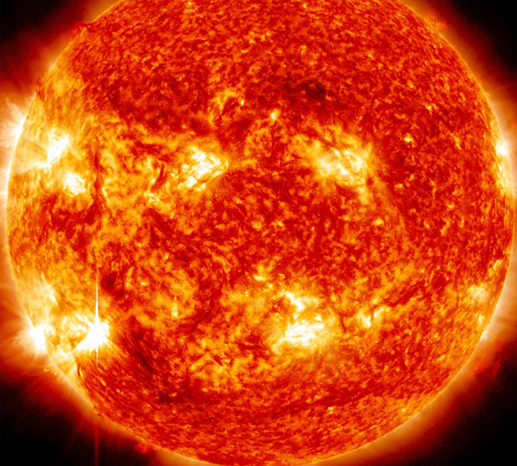
The sun is a yellow dwarf star, a hot ball of glowing gases at the heart of our solar system made of hydrogen and helium. Its influence extends far beyond the orbits of distant Neptune and Pluto. Without the sun's intense energy and heat, there would be no life on Earth. The sun has made life on Earth possible, providing warmth as well as energy that organisms like plants use to form the basis of many food chains. The temperature at the sun's core is about 27 million degrees Fahrenheit (15 million degrees Celsius) while the surface temperature is 10,000 degrees Fahrenheit (about 5,500 degrees Celsius). With an average diameter of 864,000 miles, the sun is about 109 times the size of the Earth.
The sun's enormous mass is held together by gravitational attraction, producing immense pressure and temperature at its core. The sun has six regions: the core, the radiative zone, and the convective zone in the interior; the visible surface, called the photosphere; the chromosphere; and the outermost region, the corona. The surface of the sun, the photosphere, is a 300-mile-thick (500-kilometer-thick) region, from which most of the sun's radiation escapes outward. This is not a solid surface like the surfaces of planets. Instead, this is the outer layer of the gassy star.
Explore the Planets

Mercury

Venus

Earth

Mars

Jupiter

Saturn

Uranus

Neptune
Mercury
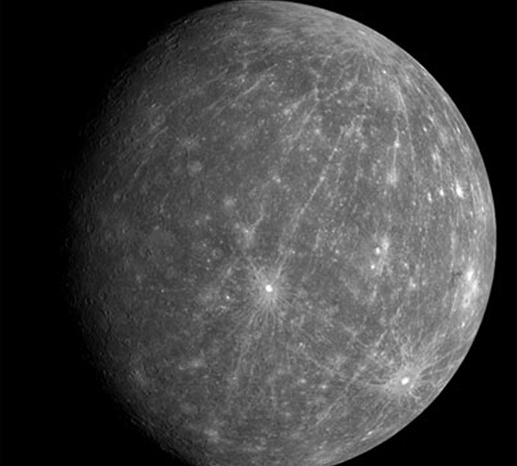
Mercury's eccentric orbit takes the small planet as close as 47 million km (29 million miles) and as far as 70 million km (43 million miles) from the sun, making it the closest planet to the sun. Temperatures on Mercury's surface can reach 800 degrees Fahrenheit (430 degrees Celsius). Because the planet has no atmosphere to retain that heat, nighttime temperatures on the surface can drop to -290 degrees Fahrenheit (-180 degrees Celsius). Mercury's surface resembles that of Earth's Moon, scarred by many impact craters resulting from collisions with meteoroids and comets. Mercury speeds around the sun every 88 days, traveling through space at nearly 50 km (31 miles) per second, faster than any other planet. One Mercury solar day (one day-night cycle) equals 175.97 Earth days.
Mercury is the second densest planet after Earth, with a large metallic core having a radius of about 2,000 km (1,240 miles), about 80 percent of the planet's radius. In 2007, researchers used ground-based radars to study the core, and found evidence that it is partly molten (liquid). Mercury's outer shell, comparable to Earth's outer shell, is only about 400 km (250 miles) thick. Mercury, unlike Earth, does not have a moon in its orbit. The planet is appropriately named after the swiftest of the ancient Roman gods, Mercury, the god of commerce, is the Roman counterpart to the ancient Greek god Hermes, the messenger of the gods.
Venus
Venus is the second planet from the sun and our closest planetary neighbor. Similar in structure and size to Earth, Venus spins slowly in the opposite direction most planets do. Its thick atmosphere traps heat in a runaway greenhouse effect, making it the hottest planet in our solar system. Venus is named after the ancient Roman goddess of love and beauty, the counterpart to the Greek goddess Aphrodite.
Venus' rotation and orbit are unusual in several ways. Venus is one of just two planets that rotate from east to west. Only Venus and Uranus have this "backwards" rotation. It completes one rotation in 243 Earth days — the longest day of any planet in our solar system, even longer than a whole year on Venus. But the sun doesn't rise and set each "day" on Venus like it does on most other planets. On Venus, one day-night cycle takes 117 Earth days because Venus rotates in the direction opposite of its orbital revolution around the sun.
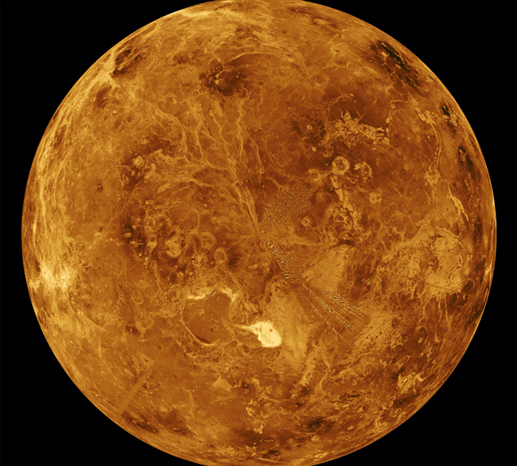
From space, Venus is bright white because it is covered with clouds that reflect and scatter sunlight. At the surface, the rocks are different shades of grey, like rocks on Earth, but the thick atmosphere filters the sunlight so that everything would look orange if you were standing on Venus. It is thought that Venus was completely resurfaced by volcanic activity 300 to 500 million years ago.
Earth
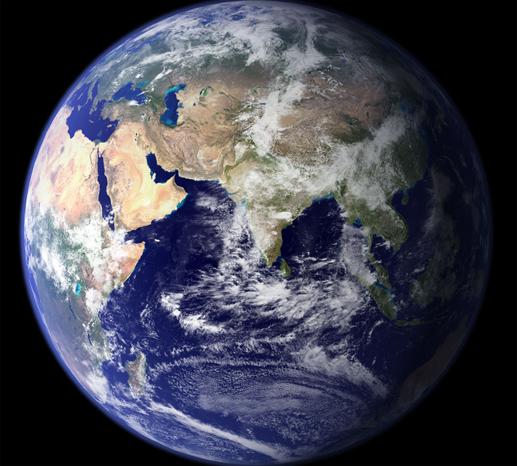
Earth is the third planet from the sun and the fifth largest in the solar system. Our home planet is the only planet in our solar system known to harbor living things. All of the planets, except for Earth, were named after Greek and Roman gods and goddesses. However, the name Earth is an English/German word, which simply means the ground. With a radius of 3,959 miles (6,371 kilometers), Earth is the biggest of the terrestrial planets.
As Earth orbits the sun, it completes one rotation every 23.9 hours. It takes 365.25 days to complete one trip around the sun. That extra quarter of a day presents a challenge to our calendar system, which counts one year as 365 days. To keep our yearly calendars consistent with our orbit around the sun, every four years we add one day.
Earth's axis of rotation is tilted 23.4 degrees with respect to the plane of Earth's orbit around the sun. This tilt causes our yearly cycle of seasons. During part of the year, the northern hemisphere is tilted toward the sun and the southern hemisphere is tilted away. With the sun higher in the sky, solar heating is greater in the north producing summer there. Less direct solar heating produces winter in the south. Six months later, the situation is reversed. When spring and fall begin, both hemispheres receive roughly equal amounts of heat from the sun.
Earth is the only planet that has a single moon. Our moon is the brightest and most familiar object in the night sky. In many ways, the moon is responsible for making Earth such a great home. It stabilizes our planet's wobble, which has made the climate less variable over thousands of years.
Mars
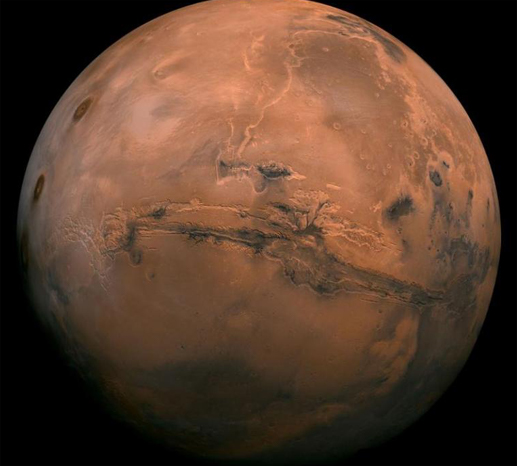
Mars is a rocky body about half the size of Earth. As with the other terrestrial planets - Mercury, Venus, and Earth - volcanoes, impact craters, crustal movement, and atmospheric conditions such as dust storms have altered the surface of Mars. Like Earth, Mars experiences seasons due to the tilt of its rotational axis. Mars' orbit is about 1.5 times farther from the sun than Earth's and is slightly elliptical, so its distance from the sun changes. That affects the length of Martian seasons, which vary in length. The polar ice caps on Mars grow and recede with the seasons. Layered areas near the poles suggest that the planet's climate has changed more than once.
Mars was named by the Romans for their god of war because of its red, bloodlike color. Other civilizations also named this planet from this attribute; for example, the Egyptians named it "Her Desher," meaning "the red one."
Jupiter
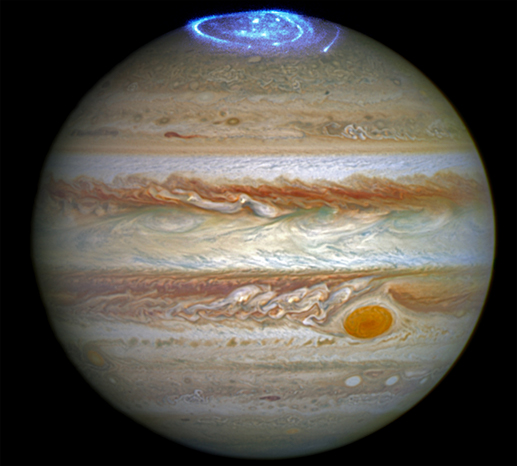
Jupiter is the fifth planet from our sun and the largest planet in the solar system. Jupiter's stripes and swirls are cold, windy clouds of ammonia and water. The atmosphere is mostly hydrogen and helium, and its iconic Great Red Spot is a giant storm bigger than Earth that has raged for hundreds of years. Jupiter is surrounded by 53 confirmed moons, as well as 16 provisional ones — for a possible total of 69 moons. Scientists are most interested in the "Galilean satellites" — the four largest moons discovered by Galileo Galilei in 1610: Europa, Callisto, Ganymede and Io. Jupiter also has three rings, but they are very hard to see and not nearly as intricate as Saturn's.
The composition of Jupiter is similar to that of the sun — mostly hydrogen and helium. Deep in the atmosphere, pressure and temperature increase, compressing the hydrogen gas into a liquid. This gives Jupiter the largest ocean in the solar system — an ocean made of hydrogen instead of water. Scientists think that, at depths perhaps halfway to the planet's center, the pressure becomes so great that electrons are squeezed off the hydrogen atoms, making the liquid electrically conducting like metal. Jupiter's fast rotation is thought to drive electrical currents in this region, generating the planet's powerful magnetic field. It is still unclear if, deeper down, Jupiter has a central core of solid material or if it may be a thick, super-hot and dense soup. It could be up to 90,032 degrees Fahrenheit (50,000 degrees Celsius) down there, made mostly of iron and silicate minerals (similar to quartz).
Jupiter's appearance is a tapestry of colorful cloud bands and spots. The gas planet likely has three distinct cloud layers in its "skies" that, taken together, span about 44 miles (71 kilometers). The top cloud is probably made of ammonia ice, while the middle layer is likely made of ammonium hydrosulfide crystals. The innermost layer may be made of water ice and vapor. Jupiter is named for the king of ancient Roman gods.
Saturn
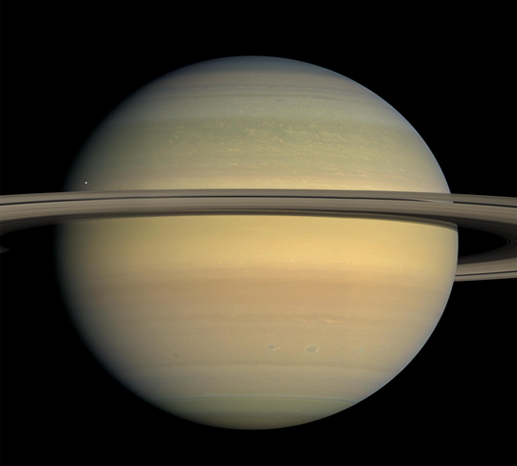
The second largest planet in our solar system, adorned with thousands of beautiful ringlets, Saturn is unique among the planets. It is not the only planet to have rings -- made of chunks of ice and rock -- but none are as spectacular or as complicated as Saturn's. Like fellow gas giant Jupiter, Saturn is a massive ball of mostly hydrogen and helium.
Surrounding by 53 confirmed and nine provisional moons, Saturn is home to some of the most fascinating landscapes in our solar system. From the jets of Enceladus to the methane lakes on smoggy Titan, the Saturn system is a rich source of scientific discovery and still holds many mysteries.
The farthest planet from Earth observable by the unaided human eye, Saturn has been known since ancient times and is named for the Roman god of agriculture and wealth. The Greek equivalent was Cronos, the father of Zeus/Jupiter.
Uranus
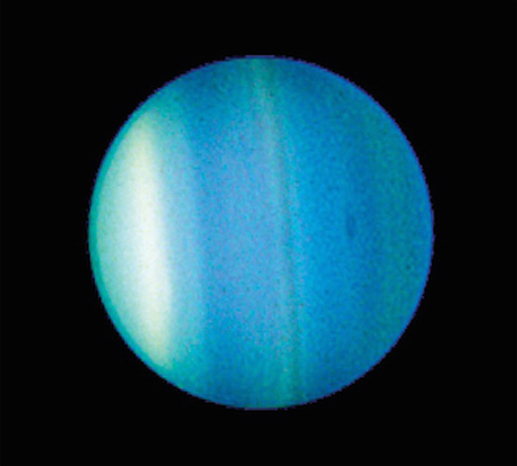
The seventh planet from the sun with the third largest diameter in our solar system, Uranus is very cold and windy. The ice giant is surrounded by 13 faint rings and 27 small moons as it rotates at a nearly 90-degree angle from the plane of its orbit. This unique tilt makes Uranus appear to spin on its side, orbiting the sun like a rolling ball. The first planet found with the aid of a telescope, Uranus was discovered in 1781 by astronomer William Herschel and named after the Roman god of the sky.
Uranus is the only planet whose equator is nearly at a right angle to its orbit, with a tilt of 97.77 degrees — possibly the result of a collision with an Earth-sized object long ago. This unique tilt causes the most extreme seasons in the solar system. For nearly a quarter of each Uranian year, the sun shines directly over each pole, plunging the other half of the planet into a 21-year-long, dark winter. Uranus is also one of just two planets that rotate in the opposite direction than most of the planets (Venus is the other one), from east to west.
Uranus is one of two ice giants in the outer solar system (the other is Neptune). Most (80 percent or more) of the planet's mass is made up of a hot dense fluid of "icy" materials - water, methane and ammonia - above a small rocky core. Near the core, it heats up to 9,000 degrees Fahrenheit (4,982 degrees Celsius). Uranus gets its blue-green color from methane gas in the atmosphere. Sunlight passes through the atmosphere and is reflected back out by Uranus' cloud tops. Methane gas absorbs the red portion of the light, resulting in a blue-green color.
Neptune
The ice giant Neptune was the first planet located through mathematical predictions rather than through regular observations of the sky. (Galileo had recorded it as a fixed star during observations with his small telescope in 1612 and 1613.) When Uranus didn't travel exactly as astronomers expected it to, a French mathematician, Urbain Joseph Le Verrier, proposed the position and mass of another as yet unknown planet that could cause the observed changes to Uranus' orbit. After being ignored by French astronomers, Le Verrier sent his predictions to Johann Gottfried Galle at the Berlin Observatory, who found Neptune on his first night of searching in 1846. Seventeen days later, its largest moon, Triton, was also discovered.
Nearly 4.5 billion kilometers (2.8 billion miles) from the Sun, Neptune orbits the Sun once every 165 years. It is invisible to the naked eye because of its extreme distance from Earth. Interestingly, the highly eccentric orbit of the dwarf planet Pluto brings Pluto inside Neptune's orbit for a 20-year period out of every 248 Earth years. Pluto can never crash into Neptune, though, because for every three laps Neptune takes around the Sun, Pluto makes two. This repeating pattern prevents close approaches of the two bodies.
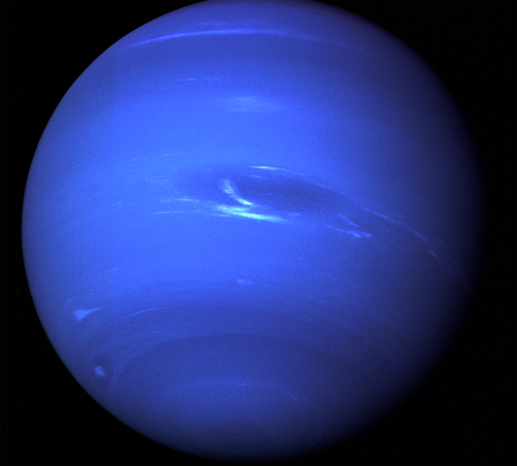
Neptune's atmosphere extends to great depths, gradually merging into water and other melted ices over a heavier, approximately Earth-size solid core. Neptune's blue color is the result of methane in the atmosphere. Uranus' blue-green color is also the result of atmospheric methane, but Neptune is a more vivid, brighter blue, so there must be an unknown component that causes the more intense color. Neptune was named for the Roman god of the sea.