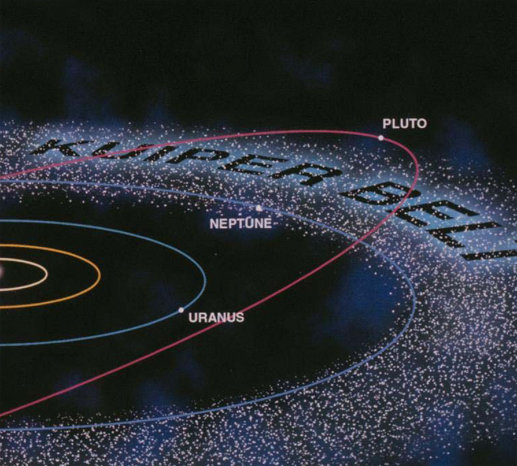

Kuiper Belt
The Kuiper Belt is a disc-shaped region beyond Neptune that extends from about 30 to 55 astronomical units (compared to Earth which is one astronomical unit, or AU, from the sun). This distant region is probably populated with hundreds of thousands of icy bodies larger than 100 km (62 miles) across and an estimated trillion or more comets.
Dwarf planet Pluto may be the best known of the larger objects in the Kuiper Belt. Comets from the Kuiper Belt take less than 200 years to orbit the sun and travel approximately in the plane in which most of the planets orbit the sun. Objects in the Kuiper Belt are presumed to be remnants from the formation of the solar system about 4.6 billion years ago.
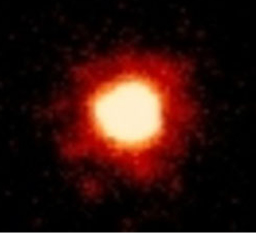
The first of these strange bodies, which astronomers call Kuiper Belt Objects (KBOs), came to light in 1992, discovered by Dave Jewitt and Jane Luu -- a pair of scientists who didn't believe the outer solar system was empty. Beginning in 1987 they had doggedly scanned the heavens in search of dim objects beyond Neptune. It took five years, looking off-and-on through the University of Hawaii's 2.2 m telescope, but they finally found what they were after: a reddish-colored speck 44 AU from the Sun -- even more distant than Pluto! Jewitt (University of Hawaii) and Luu (UC Berkeley) wanted to name their find "Smiley," but it has since been cataloged as "1992 QB1."
That discovery marked our first glimpse of the long-sought Kuiper Belt, named after Gerard Kuiper who, in 1951, proposed that a belt of icy bodies might lay beyond Neptune. It was the only way, he figured, to solve a baffling mystery about comets: Some comets loop through the solar system on periodic orbits of a half-dozen years or so. They encounter the Sun so often that they quickly evaporate -- vanishing in only a few hundred thousand years. Astronomers call them "short-period comets," although "short-lived" is more to the point. Short-period comets evaporate so quickly compared to the age of the solar system that we shouldn't see any, yet astronomers routinely track dozens of them. It was a real puzzle.
Dwarf Planets
Pluto
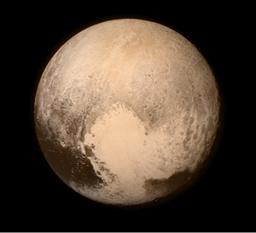
Pluto is classified as a dwarf planet and is also a member of a group of objects that orbit in a disc-like zone beyond the orbit of Neptune called the Kuiper Belt. This distant realm is populated with thousands of miniature icy worlds, which formed early in the history of our solar system. These icy, rocky bodies are called Kuiper Belt objects or transneptunian objects.
Pluto is about two-thirds the diameter of Earth's moon and probably has a rocky core surrounded by a mantle of water ice. More exotic ices like methane and nitrogen frost coat its surface. Owing to its size and lower density, Pluto's mass is about one-sixth that of Earth's moon. Pluto is more massive than Ceres -- the dwarf planet that resides in the asteroid belt between Mars and Jupiter -- by a factor of 14.
Pluto's 248-year-long elliptical orbit can take it as far as 49.3 astronomical units (AU) from the sun. (One AU is the mean distance between Earth and the sun: about 93 million miles or 150 million kilometers.) From 1979 to 1999, Pluto was actually closer to the sun than Neptune, and in 1989, Pluto came to within 29.8 AU of the sun, providing rare opportunities to study this small, cold, distant world.
Since its orbit is so elliptical, when Pluto is close to the sun, its surface ices sublimate, changing directly from solid to a gas, and rise and temporarily form a thin atmosphere. Pluto's low gravity (about six percent of Earth's) causes the atmosphere to be much more extended in altitude than our planet's atmosphere. Pluto becomes much colder during the part of each orbit when it is traveling far away from the sun. During this time, the bulk of the planet's atmosphere is thought to freeze and fall as snow to the surface.
Eris
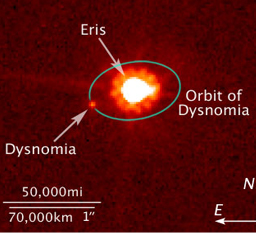
Eris was first spotted in 2003 during a Palomar Observatory survey of the outer solar system by Mike Brown, a professor of planetary astronomy at the California Institute of Technology; Chad Trujillo of the Gemini Observatory; and David Rabinowitz of Yale University. The discovery was confirmed in January 2005, and was submitted as a possible 10th planet of our solar system since it was the first object in the Kuiper Belt found to be bigger than Pluto.
It takes icy Eris 557 Earth years to complete a single orbit around our sun. The plane of Eris' orbit is well out of the plane of the solar system's planets and extends far beyond the Kuiper Belt, a zone of icy debris beyond the orbit of Neptune.
The dwarf planet is often so far from the sun that its atmosphere collapses and freezes on the surface in an icy glaze. The coating gleams brightly, reflecting as much sunlight as freshly fallen snow. Scientists believe surface temperatures to vary from about -359 degrees Fahrenheit (-217 degrees Celsius) to -405 degrees Fahrenheit (-243 degrees Celsius). The thin atmosphere will thaw in hundreds of years as Eris gets closer to the sun, revealing a rocky surface scientists believe is similar to Pluto.
Eris first appeared to be larger than Pluto, a discovery that triggered debate in the scientific community and eventually led to the International Astronomical Union's decision in 2006 to clarify the definition of a planet. Recent observations indicate Eris may actually be a little smaller than Pluto. Pluto, Eris and other similar objects are now classified as dwarf planets. They also are called plutoids in recognition of Pluto's special place in our history.
Haumea
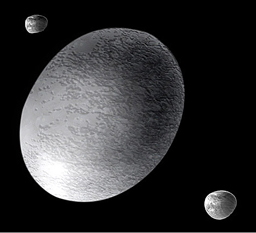
Oddly-shaped Haumea is one of the fastest rotating large objects in our solar system. It completes a turn on its axis every four hours. The quick spin elongated the dwarf planet into the unique shape astronomers discovered in 2003. It is roughly the same size as Pluto. Like Pluto and Eris, Haumea orbits our Sun in the Kuiper Belt, a distant zone of icy objects beyond the orbit of Neptune.It takes 285 Earth years for Haumea to make one orbit around our sun.
It is possible a massive impact billions of years ago set off Haumea's spin and created its moons. Haumea's known moons are Hi'aka and Namaka. Astronomers believe Haumea is a made of rock with a coating of ice. Haumea was discovered in March 2003 at the Sierra Nevada Observatory in Spain. The official announcement of its discovery came in 2005, the same year its moons were discovered.
Makemake
Along with fellow dwarf planets Pluto and Haumea, Makemake is located in the Kuiper Belt, a region outside the orbit of Neptune. Astronomers believe it is slightly smaller than Pluto. It takes 310 Earth years for this dwarf planet to make one orbit around our Sun.
Astronomers found signs of frozen nitrogen on Makemake's surface. Frozen ethane and methane have also been detected on the surface. Astronomers believe the methane may actually be present in pellets as large as one centimeter in diameter. They found evidence of tholins, molecules that form whenever solar ultraviolet light interacts with substances such as ethane and methane. Tholins usually cause a reddish-brown color and Makemake does have a reddish color in observations.
Makemake holds an important place in the solar system because it -- along with Eris -- was one of the objects whose discovery prompted the International Astronomical Union to reconsider the definition of a planet and to create the new group of dwarf planets. Makemake was first observed in March 2005 by M.E. Brown, C.A. Trujillo, and D.L. Rabinowitz at the Palomar Observatory. Its unofficial codename was Easterbunny. It was officially recognized as a dwarf planet by the International Astronomical Union in 2008.
Planet X
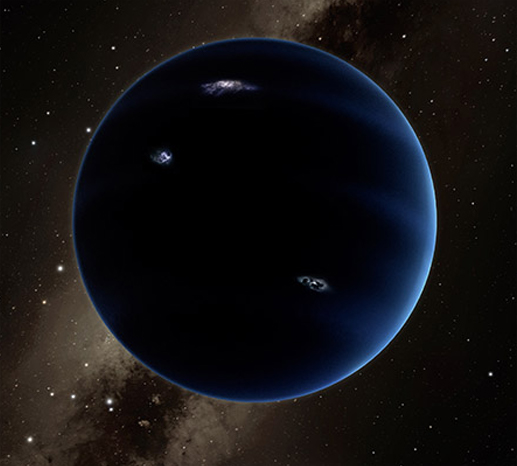
Caltech researchers have found evidence suggesting there may be a "Planet X" deep in the solar system. This hypothetical Neptune-sized planet orbits our sun in a highly elongated orbit far beyond Pluto. The object, which the researchers have nicknamed "Planet Nine," could have a mass about 10 times that of Earth and orbit about 20 times farther from the sun on average than Neptune. It may take between 10,000 and 20,000 Earth years to make one full orbit around the sun.
The announcement does not mean there is a new planet in our solar system. The existence of this distant world is only theoretical at this point and no direct observation of the object nicknamed have been made. The mathematical prediction of a planet could explain the unique orbits of some smaller objects in the Kuiper Belt, a distant region of icy debris that extends far beyond the orbit of Neptune. Astronomers are now searching for the predicted planet.
In January 2015, Caltech astronomers Konstantin Batygin and Mike Brown announced new research that provides evidence of a giant planet tracing an unusual, elongated orbit in the outer solar system. The prediction is based on detailed mathematical modeling and computer simulations, not direct observation. This large object could explain the unique orbits of at least five smaller objects discovered in the distant Kuiper Belt.
"The possibility of a new planet is certainly an exciting one for me as a planetary scientist and for all of us," said Jim Green, director of NASA's Planetary Science Division. "This is not, however, the detection or discovery of a new planet. It's too early to say with certainty there's a so-called Planet X. What we're seeing is an early prediction based on modeling from limited observations. It's the start of a process that could lead to an exciting result."