
Overview
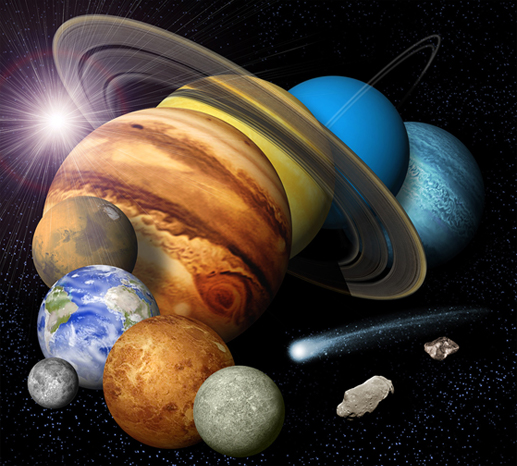
A solar system is a star and all of the objects that travel around it — planets, moons, asteroids, comets and meteoroids. Most stars host their own planets, so there are likely tens of billions of other solar systems in the Milky Way galaxy alone. Solar systems can also have more than one star. These are called binary star systems if there are two stars, or multi-star systems if there are three or more stars.
The solar system we call home is located in an outer spiral arm of the vast Milky Way galaxy. It consists of the sun (our star) and everything that orbits around it. This includes the eight planets and their natural satellites (such as our moon), dwarf planets and their satellites, as well as asteroids, comets and countless particles of smaller debris.
The solar system extends much farther than the eight planets that orbit the sun. The solar system also includes the Kuiper Belt that lies past Neptune's orbit. This is a sparsely occupied ring of icy bodies, almost all smaller than the most popular Kuiper Belt Object, dwarf planet Pluto.
The order and arrangement of the planets and other bodies in our solar system is due to the way the solar system formed. Nearest the sun, only rocky material could withstand the heat when the solar system was young. For this reason, the first four planets — Mercury, Venus, Earth and Mars — are terrestrial planets. They're small with solid, rocky surfaces.
Meanwhile, materials we are used to seeing as ice, liquid or gas settled in the outer regions of the young solar system. Gravity pulled these materials together, and that is where we find gas giants Jupiter and Saturn and ice giants Uranus and Neptune.